
It is 10:00 AM on a Tuesday, and a performance marketing team is staring at a creative fatigue chart. The primary video asset for their lead-generation campaign has hit its peak; click-through rates are dipping, and the cost per acquisition is creeping up. In the old world, this would trigger a week-long scramble: brief the designers, wait for stock photo licenses, iterate on the color grading, and hope the new batch resonates.
In the generative era, the bottleneck has shifted. The problem is no longer a lack of assets; it is the friction of speed. When a team needs to deploy fifty variations of a visual concept to find the one that converts, they hit what we call the High-Throughput Paradox. You can have high-fidelity renders that take minutes to generate and cost a premium in tokens, or you can have instant, low-cost drafts that lack the professional polish required for a live ad.
Solving this requires more than just a faster GPU. It requires a tiered approach to creative operations, specifically utilizing specialized models like Nano Banana Pro and Nano Banana AI to decouple the act of exploration from the act of final rendering.
The Invisible Wall: When Generative Latency Breaks the Creative Flow
The most significant “hidden” cost in AI-driven marketing is not the subscription fee; it is the cognitive load of latency. In a high-velocity environment, a 30-second wait time for a single generation is not just a pause—it is a workflow killer. When a creator is in the “zone,” testing prompt variations for lighting, composition, and product placement, every delay forces the brain to reset.
This is where the paradox becomes apparent. Teams often default to the “best” model available, assuming that maximum quality is always the goal. However, if you are running 500+ iterations a week to find a specific aesthetic, using a heavy-weight, high-latency model for every step is a strategic error. It depletes the budget before the concept is even finalized and slows down the A/B testing cycle to a crawl.
We must acknowledge a hard truth: many current generative workflows are inefficient because they treat the first “Generate” click as the final output. This leads to a feedback loop where the team spends more time waiting for the engine to render than they do actually refining the creative strategy. For a performance marketer, speed is the only variable that allows for true optimization at scale.
Model Tiering: Decoupling Exploration from Final Execution
To maintain a sustainable ROI, successful teams are moving toward a tiered model system. This involves separating the “sketching” phase from the “production” phase.
In this workflow, Nano Banana AI serves as the high-speed engine for the exploratory layer. It is designed for near-instant validation of composition and lighting. If you need to see how a “futuristic workspace with neon accents” looks across twelve different angles, you don’t need 4K resolution yet. You need the structural logic of the image. By leveraging the lower latency of Banana AI, a marketer can cycle through dozens of versions in the time it would take a larger model to produce one.
Once the creative direction is locked—once the team agrees that the specific “mood” and “composition” are right—they pivot. This is where the switch to Nano Banana Pro happens. The focus shifts from speed to nuance, resolution, and high-fidelity texture. By reserving the “pro-tier” credits for the final 5% of the assets that will actually go live, the team effectively reduces their total cost per successful asset by as much as 60%. This is the mathematical reality of scaling: you cannot afford to be premium at every stage of the funnel.
Workflow Integration via the Banana Pro AI Canvas
The theoretical benefit of model tiering is often lost if the user has to jump between different apps or browser tabs. Context switching is the enemy of throughput. This is why a unified canvas environment is essential for professional creative operations.
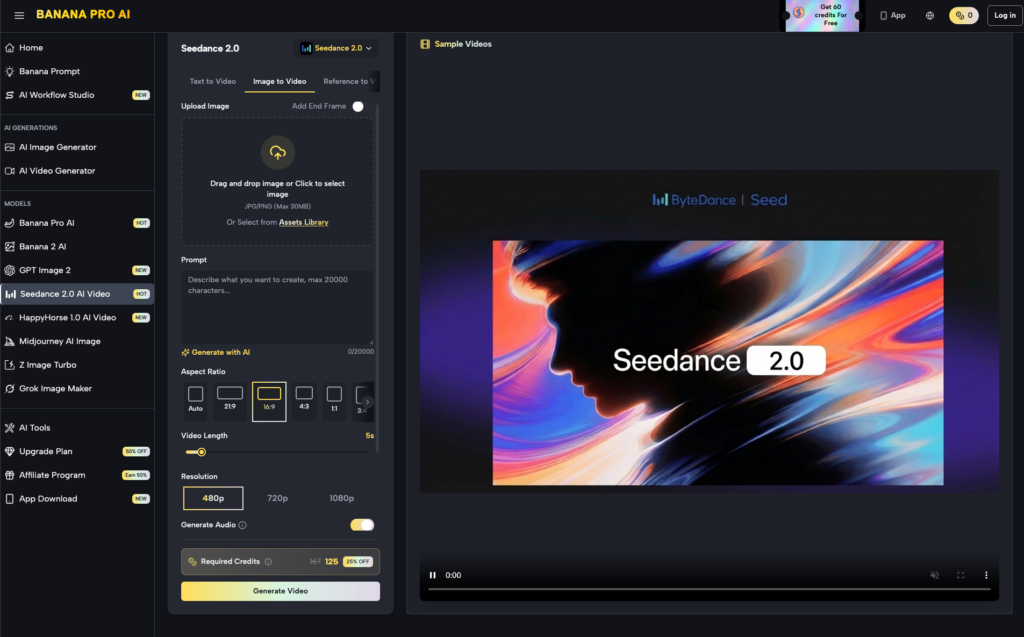
Inside the Banana Pro AI workspace, the transition between different model strengths is handled within a single interface. A creator can start with a low-res generation, refine the prompt, and then use image-to-image tools to “up-level” that specific seed into a high-fidelity output. This keeps seed consistency across model shifts—a notoriously difficult task in generative media.
Furthermore, the role of a professional canvas is to fix “hallucinations” without restarting the process. If a generation is perfect except for a stray artifact or a slightly off-model hand, the ability to perform surgical in-painting or layer adjustments saves more time than a thousand rapid prompts ever could. The integration of these tools allows for a “non-destructive” creative process, where the initial speed of Nano Banana is preserved through the refinement phase.
Quantifying Quality: Where Efficiency Meets Diminishing Returns
One of the most difficult questions for any creative lead is: “When is it good enough?” In performance marketing, the difference between a 95th-percentile render and a 99th-percentile render is often invisible to the consumer scrolling through a social feed at high speed.
Benchmarking visual fidelity requires an evidence-first approach. In many A/B tests, we find that the speed of iteration—the ability to test ten different “hooks” or visual metaphors—outperforms the raw technical resolution of any single image. This is why the Banana Pro ecosystem emphasizes a “sweet spot” of aesthetics. It provides enough detail to look professional and branded without the “over-baked” or plastic look that often plagues older generative models.
However, there is a limit. While Nano Banana allows for incredible volume, there are moments where high-tier rendering is non-negotiable—specifically in industries like high-end fashion or architectural visualization where the texture of a fabric or the refraction of glass carries the weight of the brand’s perceived value. Determining where your specific product sits on this spectrum is the first step in building an efficient pipeline.
The Limits of Scalability: What We Cannot Automate Yet
Despite the advancements in models like Nano Banana Pro, we must remain grounded about the current state of the technology. There are significant hurdles that automation hasn’t cleared yet, and ignoring them leads to “automated” workflows that actually require more manual fix-it work in the long run.
First, brand-safe color consistency remains a persistent challenge. While prompts can specify hex codes, the probabilistic nature of diffusion models means that “Brand Blue” can shift subtly across fifty different generations. Maintaining this across a large batch of assets still requires a human eye or a very strict post-processing filter.
Second, the “cost-per-generation” equilibrium is not static. As models become more efficient, the temptation is to generate more, which often leads to “content bloat” rather than better performance. Uncertainty also exists in the longevity of specific model architectures; what works perfectly today with Nano Banana AI might be superseded by a new update in six months, requiring teams to re-calibrate their prompt libraries. Human oversight is not an optional “check” at the end of the line; it is the most expensive, yet most necessary, part of the latency-cost equation.
Building a Future-Proof Pipeline for Generative Media
For teams looking to set up their operations today, the strategy should be built on flexibility rather than a single “perfect” prompt.
- Credit Budgeting: Structure your campaigns with a “credits-per-campaign” limit that accounts for both the messy exploration phase (using high-speed models) and the final delivery phase.
- API and Workflow Stability: Select tools not just based on a single impressive demo image, but on how well they integrate into a repeatable pipeline. The ability to move an image from a quick Nano Banana sketch to a finalized Pro render without losing the essence of the work is the real competitive advantage.
- Tiered Validation: Use your fastest models to test “visual concepts” in low-spend ad sets. Once a concept shows a high click-through rate, only then invest the time and tokens into producing the high-fidelity versions for the “scaling” phase of the ad spend.
The goal of utilizing a platform like Banana Pro AI is not just to make images faster; it is to reduce the cost of being wrong. By shortening the feedback loop and separating the layers of creative production, teams can afford to fail fast on twenty concepts so they can win big on the twenty-first. In the world of performance marketing, that is the only metric that truly matters.