
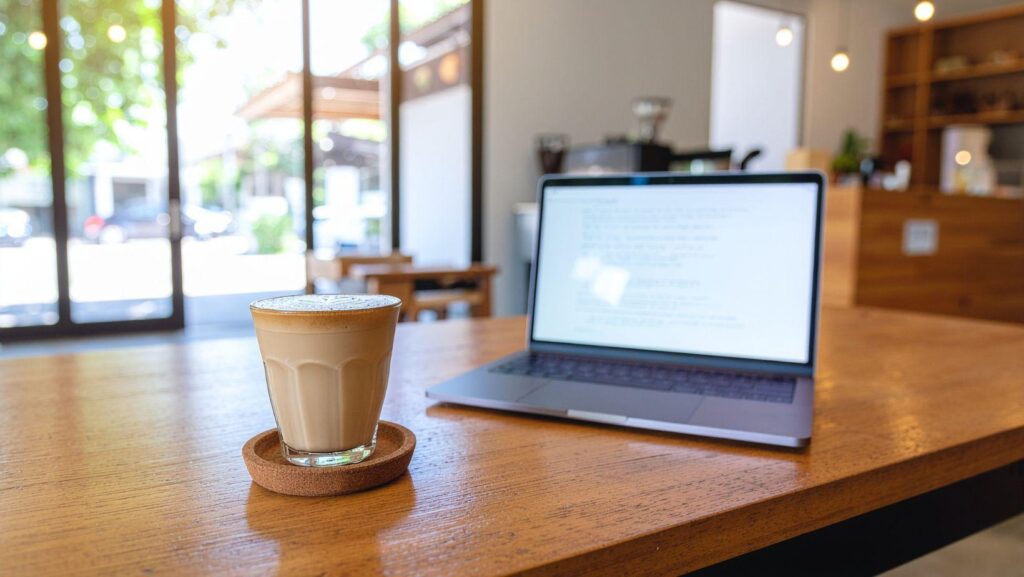
There is a moment in a lot of cafes, somewhere around two in the afternoon, when the room changes character. The lunch crowd leaves and a different set of people settles in, opens laptops, and does not move for three hours. Some rooms welcome that and some rooms empty out completely, and the difference is almost never the coffee.
It is usually a single feature of the seating. Cafes that keep an afternoon crowd have restaurant booths with power at the seat, and cafes that lose it have booths without. Everything else about the room can be identical.
The Three Hour Session Has One Hard Requirement
Start with what an afternoon worker actually needs, in order.
A laptop with four hours of battery does not last a three-hour session with video calls in it. Somewhere around the ninety-minute mark the person is watching a percentage rather than working, and at that point they are looking for a socket or looking for the door.
Everything else is negotiable. The coffee can be average, the music can be wrong, the table can be small. Power is binary, and the room either has it at the seat or it does not.
Why the Wall Socket Does Not Count
Cafes that think they have solved this frequently have not, and the reason is social rather than electrical.
A socket on a wall three feet from the booth means a cable across a walkway, which the guest knows is a hazard and knows staff will eventually mention. A socket behind a bench means crawling underneath somebody else’s seat. A socket at the far end of the room means moving to a worse table.
Any of those converts power from a feature into a negotiation, and people who are working do not want a negotiation. They want to sit down, plug in and stop thinking about it.
What Power at the Seat Actually Means
The specification worth writing is more specific than a socket somewhere nearby.
It means an outlet integrated into the booth structure or the table edge, reachable from a seated position without moving, on the same side as the person using it. Two positions per booth rather than one, because these guests arrive in pairs as often as alone. And ideally a wireless charging pad in the table surface for phones, built to the Qi standard) so it works with whatever the guest is carrying.
Equipment of that kind requires authorization before it can be sold in the United States, and the Federal Communications Commission publishes the framework it falls under. That is worth knowing when specifying, because it separates properly certified furniture components from generic imports.
The Posture Advantage Booths Already Have
Power is the trigger, and the booth is what makes the three hours survivable.
A chair supports one posture. A bench supports several: upright at the table, angled toward a screen, turned sideways, leaning into the corner. Somebody working for three hours cycles through all of them without noticing, which is precisely why they do not stand up and leave at ninety minutes.
Guidance on seated work from OSHA is written for offices and the underlying point transfers directly: sustained sitting needs postural variety far more than it needs softness. A booth provides that variety for free.
The Commercial Objection, Answered Properly
There is a real argument against all of this and it should not be dismissed.
An afternoon worker occupies a table for three hours and buys two coffees. A lunch guest occupies it for forty minutes and buys a meal. On revenue per hour of table time, the worker loses badly, and cafes that have run the numbers know it.
The counter is that the alternative for those three hours is usually an empty room. The National Restaurant Association’s own state of the industry work describes a sector operating on thin margins where fixed costs run whether the room is full or not. Two coffees from a table that would otherwise be empty is not a loss, and the same guest frequently returns at a time that is.
The mistake is offering power at the tables you need for lunch. The answer is offering it at the ones you never fill.
Where the Power Should and Should Not Go
That gives a clean design rule most cafes get backwards.
Put power in the booths furthest from the door, in the section that is dead at midday and full at three. Leave the window and the front tables without it, because those are the ones the lunch trade wants and the ones that turn.
Cafes doing this deliberately end up with a room that has two economies in it, and the seating quietly sorts guests into the right one without anybody having to enforce a policy. No signs, no time limits, no awkward conversation at the ninety-minute mark.
What to Specify if You Want the Afternoon
For a cafe planning a refit with this crowd in mind:
- Two power positions per booth, integrated and reachable without moving
- A bench deep enough to allow a change of posture, around twenty-four inches
- A table at thirty inches, since laptop work at a low table is the fastest way to lose somebody
- Power concentrated in the section that is empty at lunch, not at the window
- One freestanding accessible position adjacent to the booth run, with power
- Certified charging components rather than generic modules
The Room Nobody Planned
The interesting thing about the afternoon office is that no cafe set out to build one. The behavior arrived, some rooms accidentally accommodated it and others accidentally repelled it, and almost none of it was decided on purpose.
Rooms that accommodated it discovered a second business inside the first one, running in the hours the original business had no use for.
The equipment cost was a few sockets and a decision about which booths got them.
That is an unusually good return for a furniture detail. It is available to any cafe willing to treat two in the afternoon as a time worth designing for rather than a gap between services.